October 14, 2025
Let's Talk: How to Strategically Influence Product Decisions
How designers move beyond execution to shape product direction: through strategic frameworks, mindset shifts, and connecting design reasoning to business outcomes.
As designers, we've heard the importance of "getting a seat at the table" many times.
However, actually being there is another story. What does it mean to actively influence product decisions and not just design outcomes?
As you probably know, it takes strategy. That doesn't mean you need to know exactly what to do from the start. Instead, it's about how your thinking shapes what gets built, why it matters, and how it performs in the real world.
In this article, I'll unpack how designers can move beyond execution and start influencing the direction of a product in realistic, day-to-day ways.
What It Really Means to Influence Product Decisions Strategically
Being "strategic" isn't just about planning out goals and next steps; it's about understanding the trade-offs that drive decisions and contributing to them with clarity.
Even product managers and executives follow this when they talk about strategy. During such conversations, they often think about questions like:
- "What problem are we prioritizing?"
- "Who benefits most from solving it?"
- "What are we saying "no" to right now?"
Designers can and should be part of that conversation. Though, to do that effectively, we need to connect design reasoning to business reasoning by finding areas of overlapping values, such as showing how each design decision impacts adoption, usability, and even product direction.
In other words, strategic influence starts when design shifts from "how should this look or work?" to "how should this decision shape the experience and outcome?"
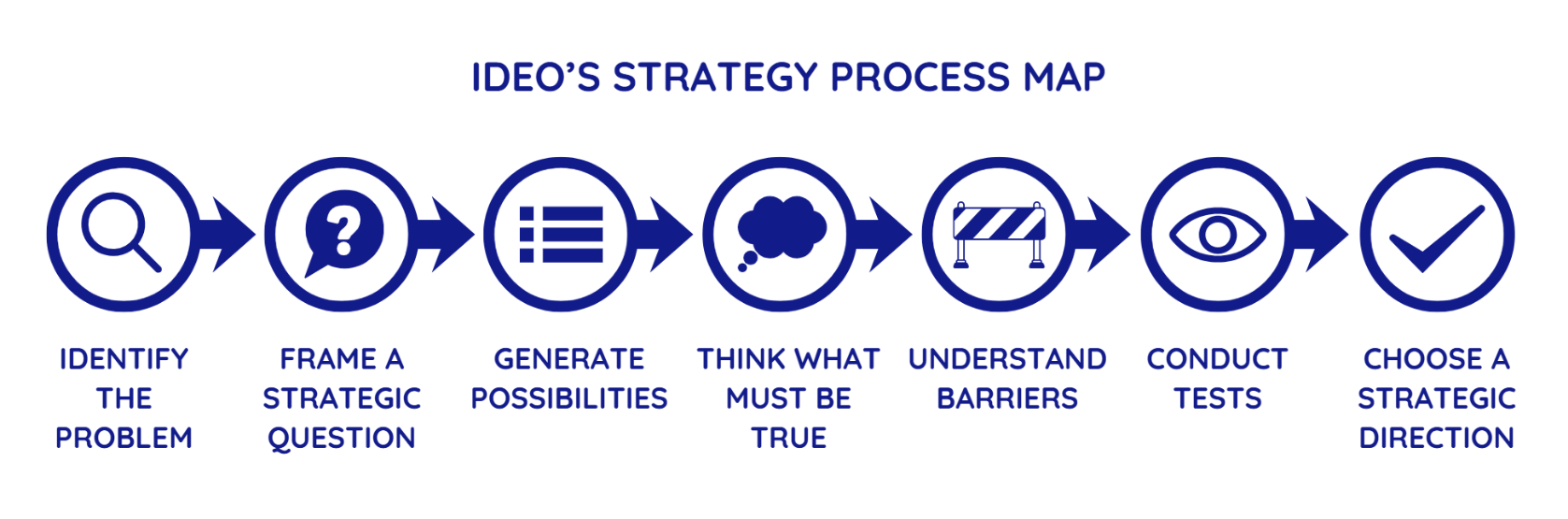
My Adaption of IDEO's Strategy Process Map
The Strategy Process Map in Practice
When we talk about influencing product direction, we're really talking about using strategic design to shape not just what we make, but why and how we make it.
There's a framework that helps with this — IDEO's Strategy Process Map — that connects design thinking with business and organizational strategy. It includes seven phases that mirror how design influences decisions in real teams:
- Identify the Problem: Discover where ambiguity lies by digging into user behavior, market signals, or stakeholder tensions. The goal is to find a problem worth solving, not just a feature to build.
- Frame a Strategic Question: Translate that problem into a question that links design, business, and user goals. This reframes the conversation toward outcomes and success metrics.
- Generate Possibilities: Explore multiple paths, user flows, or feature options. The point isn't to choose one yet; it's to create space for discussion and comparison between directions.
- Think What Must Be True: For each possibility, outline the assumptions or conditions that need to hold for it to work. Designers help make these assumptions explicit, so the team can align on risks and trade-offs.
- Understand Barriers: Investigate what might block success, whether that may be technical limits, adoption hurdles, or organizational constraints. This helps narrow down to what's both practical and impactful.
- Conduct Tests: Build prototypes or experiments to validate assumptions. This is where design begins shaping direction as it generates evidence the team can act on.
- Choose a Strategic Direction: Finally, decide which path to pursue based on what's viable, desirable, and sustainable, not just on what looks good.
Together, these steps bridge creativity and evidence, helping designers use design as a strategic tool for influence. When that happens, you're not just using business terminology; you're actively connecting design decisions to the goals you're aiming for.
Shifting Mindsets Into That of a Strategic Partner
We've seen how we can actively use design as a strategic tool, but how do we embody this role in our day-to-day beyond relying solely on a method?
In short, to consistently influence and inform product decisions, the mindset shift is just as important as the methods. Here are three reminders that help:
- Influence is built, not requested. You earn it by consistently framing design work in business and user outcomes.
- Strategy starts small. You don't need to be in every leadership meeting. Start influencing at the project level, where decisions about scope, tradeoffs, and priorities add up over time.
- Speak their language. Designers who influence product direction understand how to translate design impact into growth metrics, efficiency, or retention. Ultimately, you must clearly communicate the value and goals that matters the most to the team.
Over time, this alignment changes perception. You're no longer supporting strategy; you're shaping it. With this mindset, practicing the Strategic Design Framework also becomes easier and much more natural.

Low-Fidelity Dashboard Wireframe Early Exploration for AIAL (Made in Figma)
A Real Example: Influencing Decisions Through the AI Alignment Liaison Project
To better illustrate the frameworks and mindset shifts I've talked about so far, here's an example of where I've used design as a strategic tool to shape product decisions (using the Strategy Process Map):
- Identify the Problem: When I joined AIAL, the existing AI-generated prototype had major UX issues and no backend or LLM connection. The real problem wasn't visuals or usability; it was strategic misalignment. The team lacked a clear vision of what the product should be and how users should experience it.
- Frame a Strategic Question: Through market research, I uncovered common design and functionality patterns across generative AI tools. Presenting these helped the team define our focus: "What kind of overall experience will best serve users while aligning with AIAL's open-source values?" I decided to start with onboarding, the entry point to the entire product experience. By designing that first, I could reveal how users would navigate and engage with the rest of the system, hence turning an abstract concept into something actionable.
- Generate Possibilities: I explored three onboarding models — a pop-up, a dashboard tab, and a chatbot UI — while mapping user flows and feature relationships. This approach let me test strategic directions in a manageable scope. I also created three site map flowcharts, which made invisible assumptions visible and helped the founder see that our "happy path" wasn't necessarily every user's likely path.
- Think What Must Be True: For each model, I outlined key assumptions: users should revisit onboarding anytime, features must feel intuitive, and engagement should remain flexible. Making these explicit aligned our design direction with both user needs and future scalability.
- Understand Barriers: We faced constraints like limited development resources, evolving features, and the need for simplicity and intuitiveness in an open-source product. Recognizing these early helped us prioritize what and how to build the MVP.
- Conduct Tests: Although we paused MVP testing to prioritize the Prototype, I validated ideas through discussions with the team. We compared each concept's usability, feasibility, and user value. These discussions became critical "tests" guiding the final decision.
- Choose a Strategic Direction: We ultimately chose a dashboard-based model, not just for onboarding, but for the entire MVP. It balanced flexibility with clarity and reflected AIAL's values of openness and accessibility. This decision solidified the team's vision, gave structure to the user journey, and opened opportunities for future growth.
By applying IDEO's Strategy Process Map with a mindset of small, intentional influence, I used design not just to visualize the product, but to define its strategy for both the team and its future users.
Some Final Thoughts
Design influence doesn't happen when you wait for permission. It happens when you bring clarity to conversations that feel uncertain, and connect user value to business intent. That's the essence of strategic influence: helping teams make better product decisions by revealing what truly matters.
The best part is that you don't need to be a senior designer or design lead to do it. You just need to start thinking like a strategic partner instead of an executor. So, the next time you're in a meeting and a decision feels unclear, pause, reframe, and ask: "How does this decision shape the experience we're trying to build?"
That's how design earns its seat at the table and how you, as a designer, start shaping product strategy from within.
What's one moment where you influenced a product decision — big or small — through design?