AQUAMAA
Designing a water monitoring system that balances technical feasibility, public transparency, and policy constraints in a complex, cross-functional environment.
Role
Product Designer
Timeline
~3.5 months (Feb-May 2023)
Team
Multi-university Competition Team
Project Overview
AQUAMAA was developed as part of a multi-university competition focused on improving water quality monitoring and treatment systems.
The project required designing a complete ecosystem that integrates environmental monitoring, real-time filtration, public transparency, and regulatory constraints, all while working across teams with different technical and policy priorities.
I owned the systems strategy, cross-team synthesis, and final concept integration, ensuring the solution was technically feasible, publicly accessible, and policy-compliant.
Challenge: Two university teams approached the same competition brief with conflicting priorities --- one focused on advanced sensors and filtration and the other on public access and policy compliance --- creating a fragmented system that risked being neither technically viable nor publicly trusted.
Results: Unified a hybrid system combining in-water monitoring, floating filtration, and a transparent mobile app; submitted solution placed 6th out of 12–13 teams and demonstrated a scalable model for real-world water quality management.
The Problem
Communities in rural farmlands and near industrial areas often lack both the resources to maintain noncontamination in water bodies and timely, accessible information about water quality, leaving them vulnerable to contamination risks.
Monitoring systems are often either cost-prohibitive or technically complex for local infrastructure, while public transparency is rarely built in. The competition added another layer of difficulty: two universities started with fundamentally different proposals, one emphasizing advanced sensors and treatment and the other prioritizing policy compliance and public access. Without deliberate alignment, the final system risked being neither feasible nor trusted.
My Role
In a multi-university competition team, I focused on systems strategy, cross-functional alignment, and concept synthesis.
Responsibilities included:
- Bridging competing proposals from the two universities into a single cohesive system
- Defining technical and policy tradeoffs across monitoring, filtration, and transparency layers
- Leading ideation sessions and sketching system-level concepts
- Facilitating discussions with a sustainability expert to validate feasibility
- Refining the public transparency mobile app interface
- Integrating all components into the final competition submission
Constraints
The competition imposed strict real-world limitations:
- Extremely tight timeline with no opportunity for physical prototyping or field testing
- Regulatory requirements demanding immediate alerts and full public data access
- Limited budget, ruling out expensive fixed infrastructure
- Need for the system to work across varied environments (rivers, canals, industrial zones) without custom installations
These constraints pushed us toward modular, low-cost solutions rather than cutting-edge single technologies.
Strategy
My goal was to turn two conflicting proposals into one practical system. I did this by:
- Mapping every requirement against technical feasibility, policy rules, and public needs
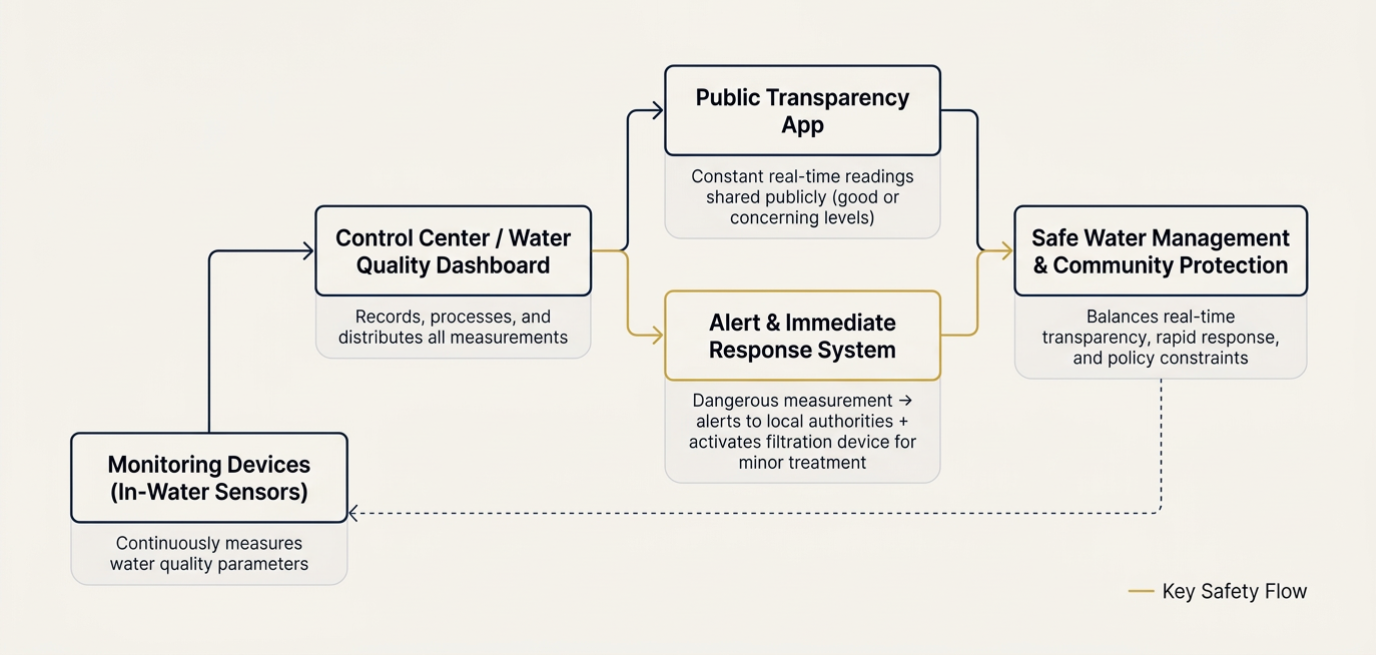
- Identifying the non-negotiable “key safety flow” (monitoring → dashboard → alert → public app)
- Choosing floating filtration units as a scalable, affordable middle layer instead of fixed plants
- Prioritizing public transparency as a core feature rather than an add-on
This systems-first mindset and layered approach let each university’s strengths coexist while staying within constraints.
Solution
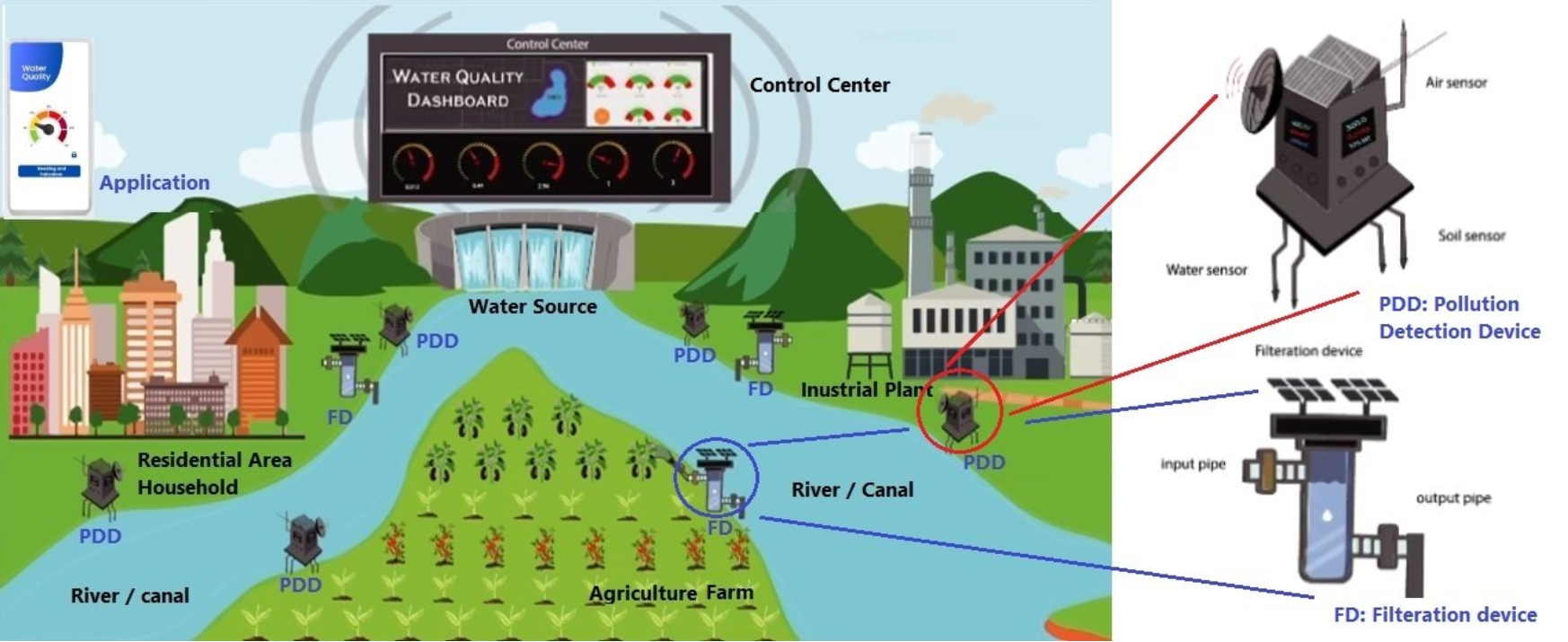
The final AQUAMAA system combined three interconnected layers:
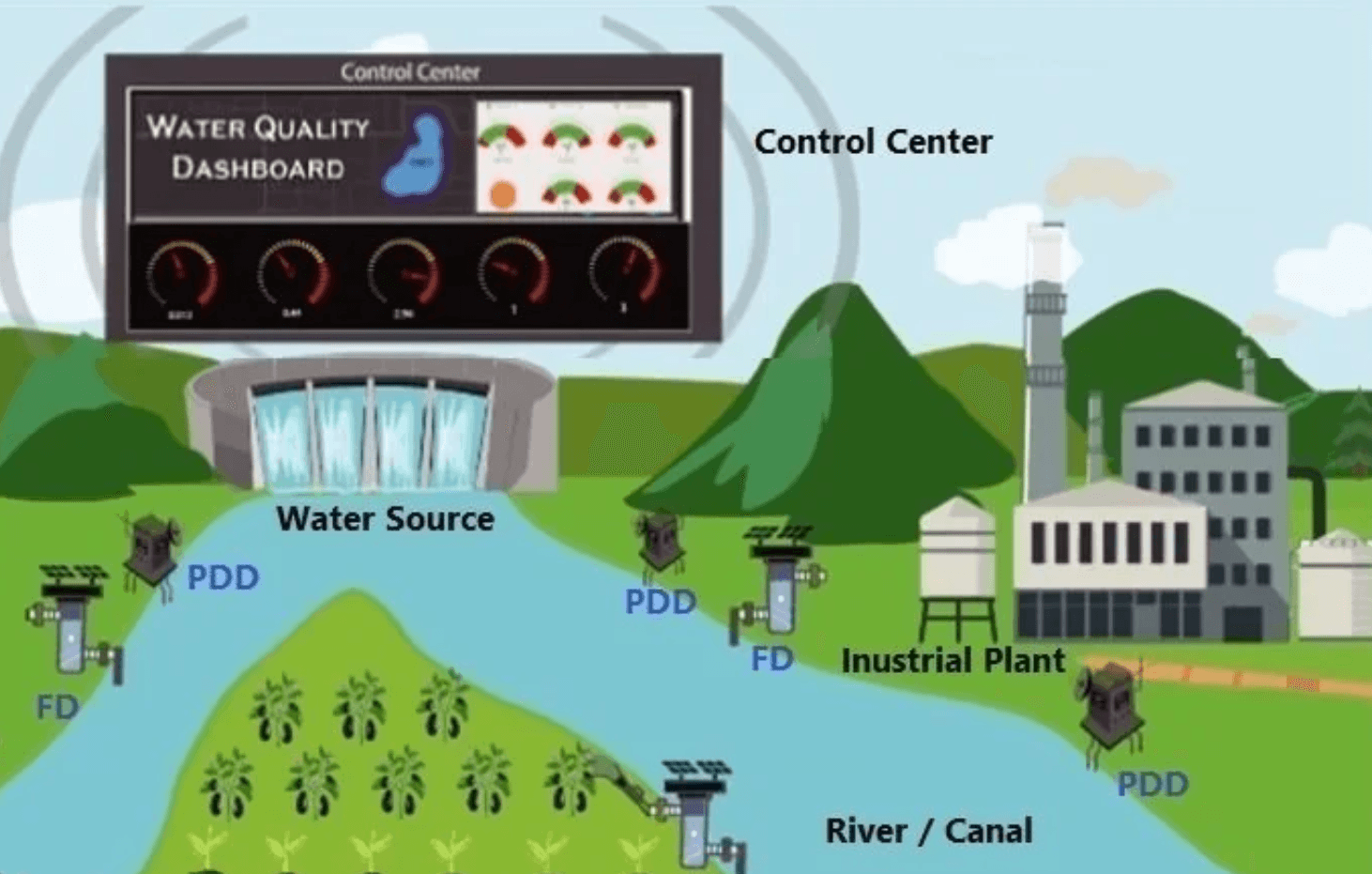
- In-water monitoring devices (PDD) continuously measure water quality parameters
- Control Center / Water Quality Dashboard records, processes, and distributes all measurements while triggering alerts
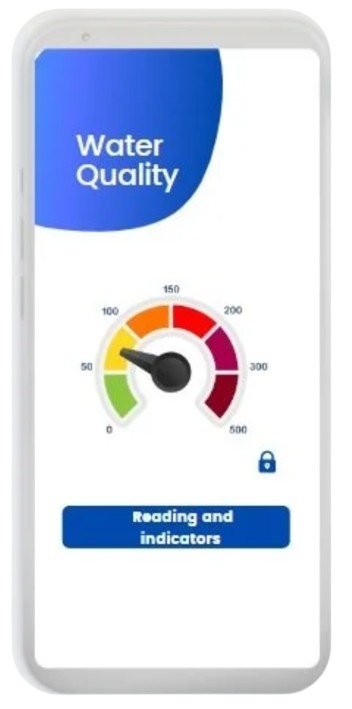
- Public Transparency App + Safe Water Management (FD) delivers constant real-time readings to the public (good or concerning) and activates immediate filtration response for dangerous levels
Floating filtration units provide deployable, low-cost treatment, while the mobile app ensures the public receives clear, actionable updates.
Full Concept Pitch Video
Watch the 4-minute competition pitch that walks through our problem-solving process and the key AQUAMAA system in action.
Outcome
The final solution was submitted to the competition judges and placed 6th out of approximately 12–13 teams.
By the end of development:
- I consulted a sustainability expert to refine technical feasibility
- Competing proposals from different universities were successfully synthesized into one unified system
- The final concept integrated monitoring, filtration, and public transparency in a way that satisfied both technical and policy requirements
Reflection
This project highlighted the importance of collaboration when multiple stakeholders bring different priorities.
Design contributions are not always limited to producing final interfaces. They can also involve facilitating discussions, synthesizing ideas, and helping teams move toward a shared solution.
Looking Forward
If more time and resources were available, I would:
- Conduct real-world field testing and validation with local communities and authorities
- Explore integration with existing municipal infrastructure for easier scaling
- Add predictive analytics to anticipate contamination events before they occur
This experience strengthened my ability to navigate ambiguity, manage cross-functional tradeoffs, and deliver systems-level solutions under real constraints.